The short version. The federal tax credit for heat pump water heaters ended on December 31, 2025. What replaced it is a patchwork of local utility rebates, and the difference between them is enormous: the same job pays $500 in some areas and $5,500 in others, depending entirely on which utility bills you and what you are replacing.
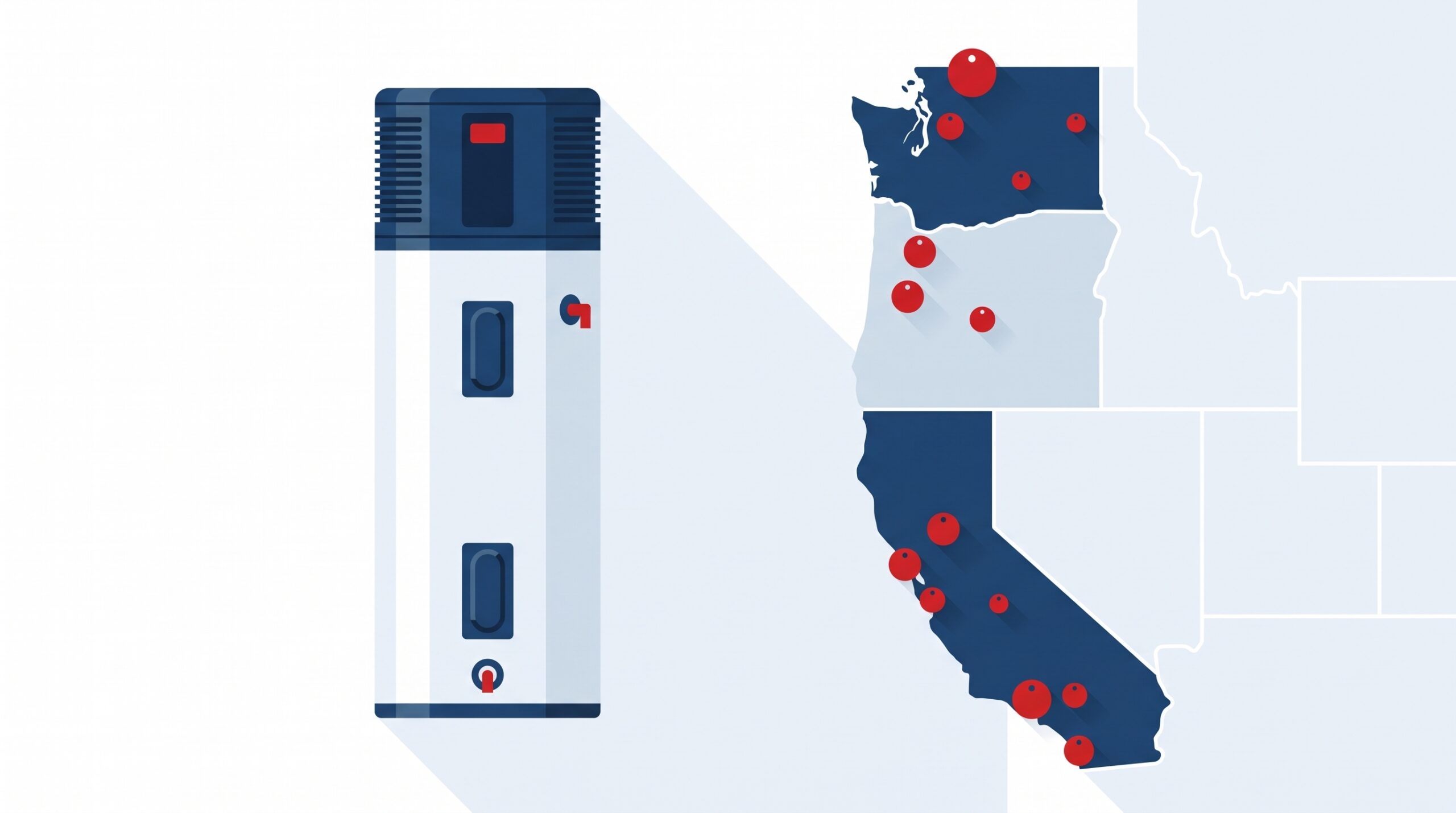
Below is every heat pump water heater rebate we could verify in Washington, Oregon and California as of September 2026, taken from each utility’s own published program page — plus the deadlines and eligibility rules that disqualify people most often.
What Changed in 2026
Two things ended, and a third never started.
The federal 25C credit is gone. The One Big Beautiful Bill Act (Public Law 119-21) terminated it. The IRS states the credit “will not be allowed for any property placed in service after December 31, 2025.” The companion 25D credit ended for expenditures made after the same date. There is no grandfathering: if you bought the unit in 2025 but it was installed in 2026, 25C does not apply, because the test is when the equipment was placed in service.
California’s statewide program is fully reserved. TECH Clean California’s single-family rebates ran out — Central and Southern California reservations closed January 7, 2026, and the rest of the state February 24, 2026. Only a waitlist remains.
The federal replacement mostly never arrived. The IRA Home Energy Rebates come in two halves. HOMES, the efficiency half, has not opened to consumers in any of the three states. HEAR, the electrification half that covers heat pump water heaters, never opened in Washington or Oregon — Oregon’s own program site says plainly: “No rebates are currently available.” California is the exception: it launched HEAR in late 2024 through TECH Clean California, which is why the money there is already gone rather than still coming. The California Energy Commission confirms single-family funds were fully reserved on February 24, 2026, with multifamily still open. Washington is awaiting Department of Energy launch approval. California is still in design.
So in 2026, your utility is the incentive. That is the whole picture — and it is why the answer varies so much from one address to the next.
Programs you will still see advertised that are no longer available
The federal 25C tax credit. Gone after December 31, 2025. The IRS’s own landing page for the credit still reads as though it is live — the termination is only stated in fact sheet FS-2025-05. Plenty of contractor sites are still advertising “up to $2,000.”
BayREN Home+ heat pump water heater rebate. Discontinued in April 2024. Still cited widely across the Bay Area.
Golden State Rebates retail coupons. The retail coupon channel ended after July 31, 2026. Reservations closed July 23 and the last redemptions were July 31; SDG&E, which held the contract, confirms the retail offerings have ended. Be careful: the program’s own marketing site still advertises the old amounts.
TECH Clean California for single-family homes. Fully reserved. A waitlist exists, but see the warning further down — installing while waitlisted disqualifies you.
Washington: Rebates by Utility
Washington has no state tax credit and no sales tax exemption for heat pump water heaters. Everything comes from your utility, and the spread is wide.
| Utility | Rebate | Key requirement | Deadline |
|---|---|---|---|
| Clark Public Utilities | $1,500 | Must replace an electric resistance storage water heater one-for-one | Not published |
| Chelan PUD | $1,300 | Existing home, replace standard electric. $1,800 income-qualified tier starting fall 2026 | Apply within 12 months |
| Puget Sound Energy | $1,000 | NEEA Tier 3 or 4. Installed on or after Jan 1, 2026. $1,100 income-qualified | Within 30 days of installation |
| Snohomish County PUD | Up to $1,000 | Replacement only, no new construction. One rebate per account per 5 years | Within 90 days of invoice |
| Lewis County PUD | $700–$900 | Tier 3 = $800, Tier 4 = $900 at 50+ gallons. Must replace an existing electric unit | Within 90 days of purchase |
| Seattle City Light | $750 | ENERGY STAR, Tier 3 or 4 on the qualified products list. One per customer | Within 93 days of purchase |
| Benton PUD | $700 / $1,100 | $1,100 for a split system. Must replace an electric tank unit | Within 6 months of purchase |
| Tacoma Power | $500 | Must replace a standard electric water heater. $2,500 income-qualified, plus a 0% loan | Permits required before install |
| Avista | $500 | Minimum UEF 2.1. Contractor and distributor only — DIY installs are not eligible | Not published |
| Grant PUD | None | No heat pump water heater rebate offered | — |
The Washington rules that catch people out
Puget Sound Energy gives you 30 days. That is the tightest window in the state — compare Chelan at twelve months. Miss it and the money is gone. PSE also requires the unit to be installed on or after January 1, 2026, so a late-2025 installation does not qualify under the current program. Either you or your installer can file; an installer can also apply the rebate as an instant discount.
Most Washington utilities require you to be replacing an electric water heater. Tacoma, Clark, Benton, Chelan and Lewis County all state this explicitly. If you are on gas and want to switch, check before you buy.
Tacoma Power wants permits pulled before installation. Install first and permit afterwards and you can be disqualified.
Avista pays the contractor, not you. It is a midstream program through participating distributors, and do-it-yourself installations are not eligible at all.
Snohomish has a five-year lockout — one rebate per account every five years, and the rebate cannot exceed what you paid for the unit.
One more thing worth knowing: Washington runs a state HEAR program funded by the Climate Commitment Act, which is separate from the federal program and is delivered through roughly 40 local administrators. Per-measure amounts are not published centrally, so if you are income-qualified it is worth asking your local administrator directly.
Oregon: Rebates by Utility
Oregon has one rule that matters more than every dollar figure on this page.
If you heat water with gas in Oregon, there is no heat pump water heater rebate for you. Energy Trust of Oregon states the unit “must replace a standard electric water heater.” Emerald PUD, Springfield Utility Board and EWEB’s income-qualified tiers all say the same. Switching from gas to a heat pump is exactly the upgrade these programs do not fund.
| Utility / program | Rebate | Key requirement | Deadline |
|---|---|---|---|
| Emerald PUD | $1,800 | Tier 4, 50+ gallons. Must replace an existing electric storage unit | Within 90 days of purchase |
| Tillamook PUD | $1,600 / $1,800 | Tier 3 / Tier 4. !Unitary units must go in unconditioned space | Within 90 days of purchase |
| Columbia River PUD | $1,500 or $1,800 | Qualified models only | Not published |
| Energy Trust of Oregon | $1,200 | Contractor-installed, Tier 3+. !Must replace a standard electric water heater | Ongoing |
| Energy Trust (retail) | $1,000 | Instant discount in store. !Online orders do not qualify, including store pickup | Ongoing |
| Springfield Utility Board | $1,100 / $2,200 | $2,200 for a split system. Must replace electric resistance tank | Not published |
| EWEB | $1,100 | $2,200 income-qualified owner-occupied. DIY allowed | Not published |
| Central Lincoln PUD | $900 | Instant discount at purchase. Installation not included | Limited-time promotion |
| Energy Trust (gas tankless) | $400 | ENERGY STAR. Must replace an existing gas storage tank water heater | Ongoing |
The Oregon rules that catch people out
Energy Trust covers five utilities, not all of them. It serves customers of Portland General Electric, Pacific Power, NW Natural, Cascade Natural Gas and Avista. If you are with EWEB, a PUD or a co-op, you go to your own utility instead — and as the table shows, several of them pay more.
Buying online disqualifies the retail discount. Energy Trust’s $1,000 instant discount requires an in-store purchase. Ordering online and collecting in store does not count.
Tillamook cares where the unit goes. A standard all-in-one heat pump water heater has to be installed in unconditioned space — an unheated garage or basement. If yours currently sits in a heated utility closet, that is a problem to solve before you shop.
EWEB makes you choose. The rebate and the 0% loan cannot be combined, unless you are income-qualified and borrowing for costs above the rebate.
Two Oregon programs are frequently listed as water heater incentives and are not. The Oregon Department of Energy’s Heat Pump Purchase Program funds space heating heat pumps only. And Oregon’s Residential Energy Tax Credit sunset in 2017 — the state no longer offers tax credits for energy devices.
California: Rebates by Utility
California is where the most has changed, and where the most outdated advice is still circulating. The statewide programs people remember are closed. What is left is municipal utilities and community choice aggregators — and several of them are now paying more than any statewide program ever did.
| Utility / program | Rebate | Key requirement | Deadline |
|---|---|---|---|
| Silicon Valley Power | $5,500 / $500 | Santa Clara. Gas-to-heat-pump / electric-to-heat-pump. Paid as a bill credit | Ongoing |
| SMUD | Up to $4,000 / $1,000 | Sacramento. !Increased Feb 2026 to offset the federal credit ending | Ongoing |
| Glendale Water & Power | $4,000 | Gas-to-heat-pump only. One per address per 10 years | Within 12 months of purchase |
| WestLight Energy | $3,500 / $500 | San Mateo County. +$1,000 CARE/FERA. Formerly Peninsula Clean Energy | Within 90 days of install |
| City of Palo Alto Utilities | $3,500 / $500 | +$500 promotion through Oct 31, 2026 | Reserve by Oct 31, 2026 |
| Silicon Valley Clean Energy | $2,500 / $1,000 | 13 Santa Clara County cities. $3,500 / $2,000 income-qualified | Must apply before installation |
| Sonoma Clean Power | $2,500 | Sonoma and Mendocino. UEF 3.43 or better | Guaranteed to Mar 1, 2028 |
| Roseville Electric | $2,500 / $1,000 | Confirm current amounts — published form dates from Feb 2025 | Within 90 days |
| Central Coast Community Energy | $150–$3,000 | Monterey, San Benito, SLO, Santa Barbara, Santa Cruz. !Program changes Oct 1, 2026 | Ongoing |
| MCE | Up to $675 | Owned and occupied 12+ months. 12-month lockout on other electrification projects | Ongoing |
| Pasadena Water & Power | $500 | One per address per 10 years | Within 180 days of purchase |
| PG&E / SCE / SDG&E / SoCalGas | None | No direct residential heat pump water heater rebate | — |
| Clean Power Alliance | None | Programs are battery, EV and demand response only | — |
| BayREN | None | Home+ heat pump water heater rebate ended April 2024 | — |
If you are on the TECH Clean California waitlist, do not install yet
The waitlist only pays out if additional funding appears — and the heat pump must be installed after your reservation is approved. Installing while you wait disqualifies you from the rebate entirely. This is the single most expensive mistake available in California right now, and almost nobody writes about it.
The California rules that catch people out
Silicon Valley Clean Energy requires pre-approval. You apply before installation and hold a 120-day reservation. That matters if your water heater has already failed — an emergency same-day replacement forfeits the rebate. WestLight works the other way round, accepting applications up to 90 days after the job.
Fuel switching is where the money is. Nearly every California program pays two to five times more for replacing a gas water heater with a heat pump than for replacing an old electric one. Glendale only pays for gas conversions at all. This is the reverse of Oregon, where gas conversions get nothing.
MCE locks you out for a year. Take the rebate and you cannot claim MCE incentives for solar, battery storage or EV charging for twelve months afterwards.
Income-qualified installs may be free. The Energy Savings Assistance program covers heat pump water heater upgrades and repairs at no charge for qualifying households, and it runs through May 2027. If money is the obstacle, start there rather than with a rebate.
What the Same Job Pays, Ranked
This is the clearest way to see it. Identical equipment, identical labour — the incentive depends almost entirely on your address.
| Rebate | Utility | State | Typical condition |
|---|---|---|---|
| $5,500 | Silicon Valley Power | CA | Gas conversion, Santa Clara |
| $4,000 | SMUD · Glendale | CA | Gas conversion |
| $3,500 | WestLight · Palo Alto | CA | Gas conversion |
| $2,500 | Silicon Valley Clean Energy · Sonoma Clean Power · Roseville | CA | Gas conversion |
| $1,800 | Emerald PUD · Tillamook PUD | OR | Tier 4, electric replacement |
| $1,500 | Clark Public Utilities · Columbia River PUD | WA / OR | Electric replacement |
| $1,300 | Chelan PUD | WA | Electric replacement |
| $1,200 | Energy Trust of Oregon | OR | Contractor-installed, electric replacement |
| $1,000–$1,100 | PSE · Snohomish · EWEB · Springfield | WA / OR | Varies |
| $675–$900 | MCE · Central Lincoln PUD | CA / OR | Varies |
| $500–$750 | Tacoma · Avista · Seattle City Light · Pasadena | WA / CA | Varies |
| $0 | PG&E · SCE · SDG&E · Clean Power Alliance · BayREN · Grant PUD | CA / WA | No program |
An eleven-fold spread, and in several large service territories the answer is zero. Before you assume a rebate is coming, check which utility actually bills you — in California in particular, your community choice aggregator and your delivery utility are different organisations with different programs.
Closing or Changing in the Next Few Weeks
Four things move between now and the end of October 2026. If one of them applies to you, timing is worth money.
| Date | What happens | Who it affects |
|---|---|---|
| October 1, 2026 | Central Coast Community Energy redesigns its Electrify Your Home program | Monterey, San Benito, SLO, Santa Barbara, Santa Cruz counties |
| October 31, 2026 | Palo Alto’s $500 bonus ends | City of Palo Alto Utilities customers |
| October 31, 2026 | WestLight’s bonus ends (up to $4,000 total) | San Mateo County |
| End of October 2026 | Silicon Valley Clean Energy’s $500 bonus ends | 13 Santa Clara County cities |
| March 1, 2028 | Sonoma Clean Power’s $2,500 drops to CARE/FERA customers only | Sonoma and Mendocino |
3CE has said it will publish the new program details in late September 2026. If you are in that territory and planning a replacement, it is worth a phone call before you commit either way.
Frequently Asked Questions
We handle the rebate paperwork
Fast Water Heater has installed water heaters across Washington, Oregon and California since 1986, and water heaters are the only trade we work. We know which program covers your address, which tier of equipment qualifies, and what the filing deadline is — because we file them every week. Tell us your address and what you have now, and we will tell you what you actually qualify for before you spend anything.
Related Reading
- Heat pump water heaters — how they work and whether one suits your home
- Water heater replacement — what the job involves
- Water heater repair — when a repair is the better call
- Water heater error codes — what the display is telling you
- Washington service areas
- Oregon service areas
- Bay Area service areas
Rebate amounts and program rules verified September 8, 2026 against each utility’s own published program page. These programs change frequently and several are funded first-come, first-served — confirm current terms with your utility before you buy. Where a utility publishes no deadline or no amount, we have said so rather than guessing.